

Time saved
The first review of large application volumes takes minutes instead of days. The team gains time for the conversations that really matter.
Guide
Automated CV screening promises to find the right candidates among hundreds of applications in minutes. This guide explains how CV parsing, keyword matching and AI screening work, what their benefits and risks are and what the GDPR and the EU AI Act require. It also shows when a CV alone is not enough for a good shortlist.
By Yeliq ·
CV screening, also called resume screening, is the first filter in the hiring process. Recruiters or software check whether the experience, education and qualifications in an application match the requirements of the job. The goal is a shorter list of candidates worth talking to.
Done manually, this takes a lot of effort. For jobs with many applicants, recruiting teams spend a large part of their time reviewing CVs. At the same time, the first look is often very brief. A widely cited eye-tracking study by the job site Ladders found an average of around seven seconds per CV.
Automated CV screening is meant to speed this up. Software reads the CVs, compares them with the job and sorts them. Many applicant tracking systems now include such features, often labelled CV parsing, matching or AI screening.
It is worth separating this from candidate screening. That is the umbrella term for the whole early selection stage. Besides the CV, it includes knockout questions, online assessments, video answers or work samples.
Most systems work in five steps. How mature they are varies from vendor to vendor, but the logic is almost always the same.
A parser reads the CV from a PDF, Word file or online profile. It detects positions, dates, employers, degrees, languages and skills and stores them in structured fields. Unusual layouts, tables or graphics can already cause reading errors here.
The extracted data is standardised. Sales Director, Head of Sales and VP Sales become one comparable role. Skills are often mapped to a taxonomy such as the European ESCO classification.
The structured data is compared with the job requirements. Depending on the system, this happens via keywords, semantic similarity or a language model that compares the CV and the job description by content.
Each application gets a score or a position in a ranking. Some systems also filter on knockout criteria such as a missing work permit or a required driving licence.
Recruiters see the sorted list and decide whom to look at more closely. How well this step works depends heavily on whether the system explains its assessment.
| Approach | How it works | Strength | Weakness | Best for |
|---|---|---|---|---|
| Keyword filter | Checks whether predefined terms appear in the CV | fast, simple and easy to explain | misses synonyms and rewards keyword stuffing | clear must-have criteria and very high application volumes |
| Semantic matching | Compares meaning based on the similarity of terms and texts | recognises related terms and phrasing | scores are often hard to trace | large talent pools and active sourcing |
| AI analysis with language models | Reads the CV and the requirements by content and summarises the fit | understands context, responsibility and career path | can invent connections and needs evidence | skilled roles with complex requirements |
In practice, many systems combine these approaches. What matters is less the technology than what the CV is checked against. Matching against a vague job ad produces weak results even with the best AI. That is why it pays to clarify the requirements of the role before screening.
The first review of large application volumes takes minutes instead of days. The team gains time for the conversations that really matter.
Candidates wait less for an answer. Strong applicants in particular are often off the market within days.
All applications are reviewed against the same standards. Mood and time pressure play a smaller role.
Structured profiles make applications comparable, even when the CVs are built in completely different ways.
Automation speeds up the review. But it brings its own sources of error that are worth knowing before you rely on a ranking.
Anyone who describes their experience in other words than the job ad drops down in keyword filters. This especially affects career changers and people from other industries.
Applicants know that software is reading along. Many tailor their CVs to keywords or have AI tools rewrite them. CVs become more alike and say less.
Systems that learn from past hires can carry old patterns forward. In one well-known case, a large online retailer dropped an experimental recruiting tool because it rated applications from women lower.
Language models can draw conclusions that are not actually in the CV. Without evidence for every statement, that is risky in hiring.
Two-column layouts, tables or embedded graphics are not always read correctly. Then information is missing before any assessment even starts.
It describes positions and titles, but not how someone works, communicates or handles pressure. For many roles, that is exactly what matters.
Anyone who analyses CVs automatically processes personal data and influences selection decisions. Clear rules apply.
Under Article 22 GDPR, applicants should generally not be subject to a decision based solely on automated processing that significantly affects them. An automatic rejection without human review is therefore problematic. Applicants must also be told transparently how their data is processed.
Equal treatment laws such as the German AGG prohibit discrimination on grounds such as gender, age, ethnic origin, religion, disability or sexual identity. This also applies when the discrimination is caused by software.
Under the EU AI Act, AI systems that filter or evaluate applications or select candidates are high-risk systems. Providers and employers must ensure risk management, data quality, documentation, transparency and human oversight, among other things.
In companies with a works council, introducing screening tools can trigger co-determination rights, for example on selection guidelines. It pays to involve the works council early.
This overview is not legal advice. For your specific use case, check with your data protection and legal teams.
Whether the CV is a sufficient signal depends on the role. These rules of thumb help.
The Yeliq approach
Yeliq treats the CV as one signal source among several. It starts with an automatically generated requirements analysis of the role, which the team reviews and approves. The CV is assessed against these requirements, not against a list of keywords.
Every assessment points to the part of the CV it is based on. Whatever remains open is flagged as a topic for the interview. Where the CV alone is not enough, the pre-interview flow adds further targeted signals. The decision is always made by the team.
Before an AI model processes a CV, Yeliq fully anonymises it. Name, photo, contact details, address, date of birth and other personal details are removed. The AI works only with experience, qualifications and skills. This protects applicants' data and meets even the highest compliance requirements.
Every role is different. Every role deserves a perfect pre-selection.
Go to the CV analysis method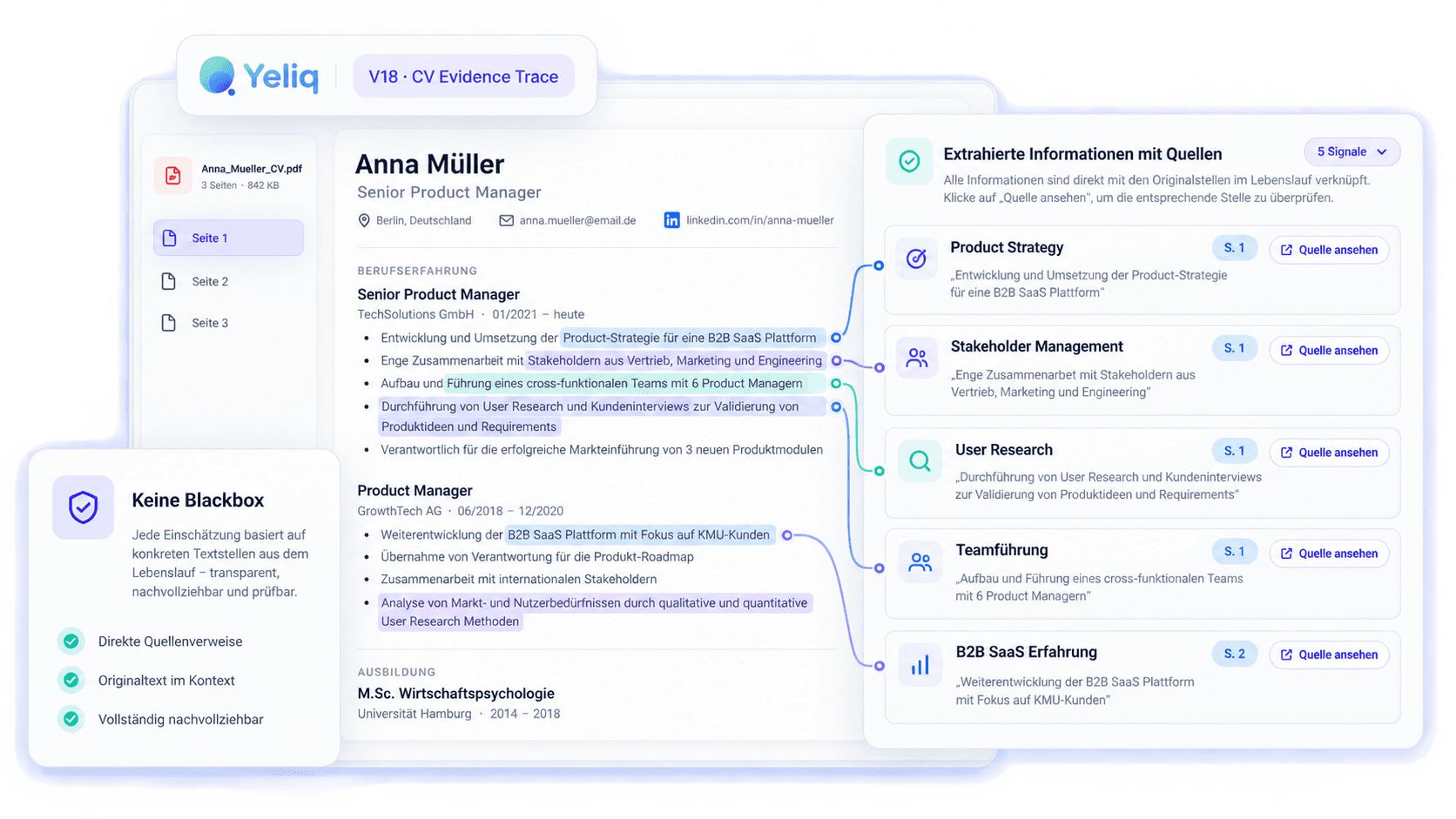
CV screening is the review of CVs to identify suitable candidates for a job. It can be done manually by recruiters or automatically by software and is usually the first filter in the hiring process.
CV parsing is the automatic extraction of information from a CV. Software detects details such as positions, dates, degrees and skills and turns them into structured data. It is the technical basis for automated screening.
AI screening uses language models that compare CVs and job requirements by content. Unlike keyword filters, they recognise meaning and context. For the results to be reliable, every assessment should point to evidence in the CV.
In principle, yes. But it must comply with the GDPR and anti-discrimination law. A purely automated rejection without human review is problematic. Under the EU AI Act, AI systems used to select applicants are also high-risk systems with special obligations.
Yes, if it learns from biased data or takes characteristics into account that are unrelated to the role. That is why bias testing, traceable assessments and human oversight are important.
That depends on the vendor and is an important selection criterion. If name, photo, contact details and other personal details are removed before the analysis, the risk that they influence the assessment goes down. The AI also processes less personal data. Yeliq fully anonymises every CV before an AI model processes it.
CV screening refers only to the CV. Candidate screening is the umbrella term for the whole early selection stage, which also includes knockout questions, tests, video answers or work samples.
Many applicant tracking systems offer CV parsing and matching. There are also specialised AI screening tools and vendors like Yeliq that combine the CV with further signals for the shortlist. The checklist in this guide helps you choose.
No. AI can speed up and structure the review. The decision about whom to invite should stay with people. That makes sense professionally and is required by law.
In a demo, we use one of your roles to show how Yeliq assesses CVs and where additional signals improve your shortlist.