
Client context changes everything
What looks strong internally does not automatically work in a demanding client setting.
Consulting
∘Yeliq helps consulting firms see earlier who copes with client work, project pressure, leadership style and team dynamics.
Expertise is the entry ticket. What matters is how someone communicates, takes ownership, handles feedback and makes an impact across changing projects.
Core thesis
In consulting, expertise isn't enough. What matters is who can take responsibility on the project and in front of the client.
What looks strong internally does not automatically work in a demanding client setting.
Structure, communication and ownership often only become visible in the project.
A strong profile can still clash with leadership style, feedback culture or project setup.
The same person can perform very differently in a research-heavy project, a transformation program or a partner-led client setting.
Clarity, structure, expectation management and professional impact.
Taking responsibility, driving topics and not waiting for perfect instructions.
Learning under pressure, handling feedback and improving quickly.
Collaboration with leadership style, project culture and feedback logic.
Ambiguity, stakeholders, top-down communication and storyline.
Analytics, implementation, hands-on process work and clear responsibility.
Interfaces between business, tech and client expectations.
Project leadership, feedback, delegation and client trust.
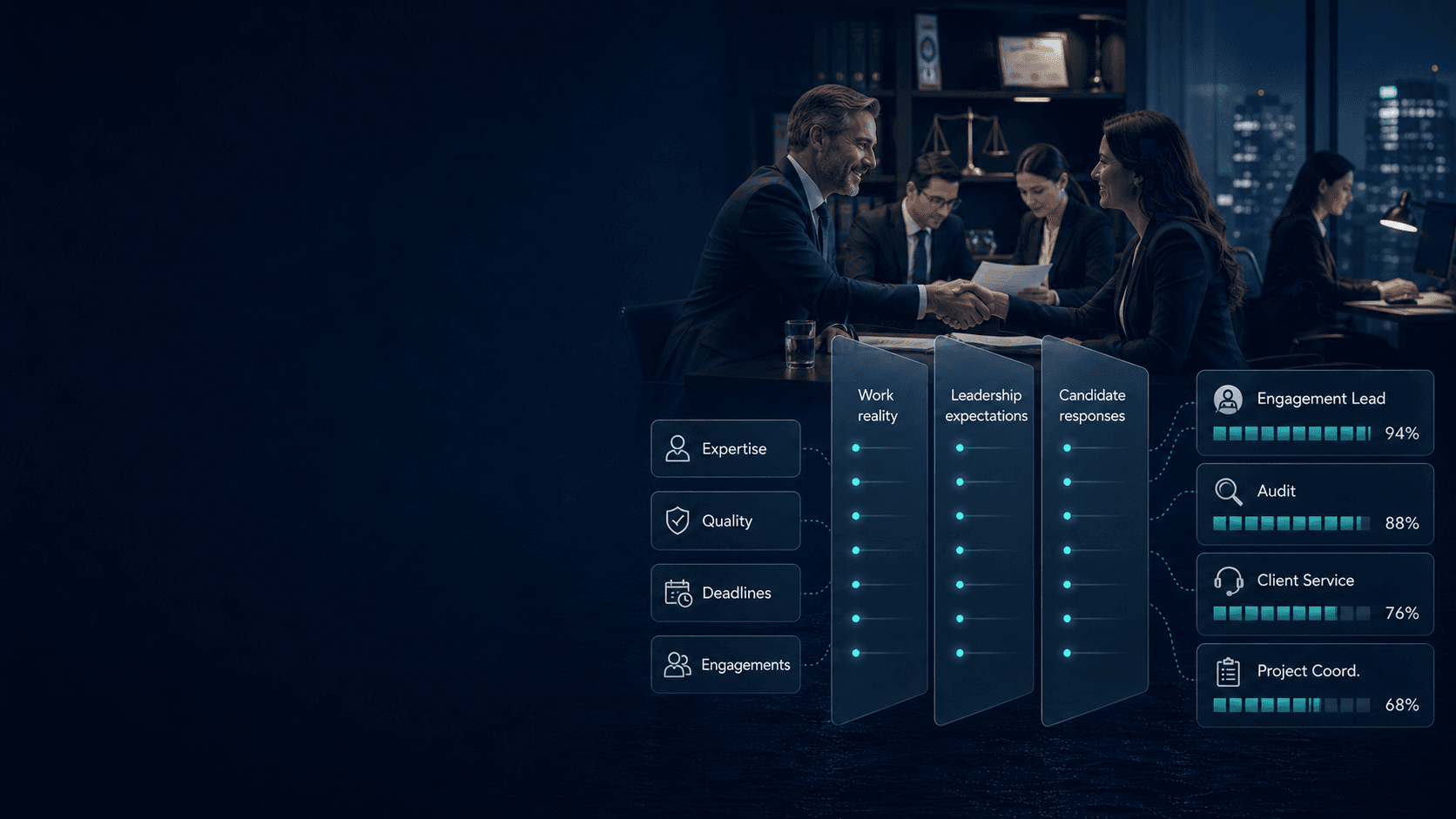
Teams define what the specific project and client require. Candidates respond to situations that reveal communication, ownership and the ability to learn.
Teams see in advance who is likely to succeed with the client.
Interviews dig into communication, feedback and ownership.
Teams avoid mismatches that would otherwise only show up at the client.
Client, pace, ambiguity, travel/hybrid and stakeholders.
Leadership style, feedback culture and expectations for ownership.
Situations around client work, pressure and communication.
A prioritization plus interview questions on the critical points.
Expertise and project fit are looked at together earlier.
Leadership and feedback become part of early prioritization.
Communication and ownership become visible earlier.
Prioritization better matches the concrete project type.
Consulting
These examples show typical configurations. The actual selection process is put together individually for each role based on its specific requirements.
| Yeliq module | ConsultantAnalysis, structure and learning curve on projects. | Senior consultantIndependent workstreams and client contact. | Engagement managerProject leadership, team and client trust. | Subject matter expertDeep expertise and translating it for clients. |
|---|---|---|---|---|
| CV analysis | ✓Recommended | ✓✓Highly relevant | ✓✓Highly relevant | ✓✓Highly relevant |
| Filter questions | ✓Recommended | ✓Recommended | ○Can be useful | ○Can be useful |
| Situational questions on working style | ✓✓Highly relevant | ✓✓Highly relevant | ✓✓Highly relevant | ✓Recommended |
| Situational questions on leadership | ✓Recommended | ✓Recommended | ✓✓Highly relevant | ○Can be useful |
| Video answer | ○Can be useful | ○Can be useful | ✓Recommended | ○Can be useful |
| Digital work sample | ✓✓Highly relevant | ✓✓Highly relevant | ✓Recommended | ✓✓Highly relevant |
Example in detail: Engagement manager
Yeliq helps teams prioritize candidates earlier based on concrete work reality, leadership expectations and collaboration. This makes candidate overviews clearer and interviews more focused.
No. The CV remains relevant. Yeliq adds signals that are usually not visible in it: context, working style, leadership fit and possible tension areas.
A pilot usually starts with one role or role cluster. Role context, leadership expectations and candidate responses are then brought together in a structured way.
No. Yeliq provides signals, prioritization and interview focus. The final evaluation and decision stay with recruiting, the hiring manager and the team.
We look at one role, level or typical project type and develop matching situations.