


The CV only shows one part
Experience, career steps and formal qualifications are visible. How someone works, communicates, makes decisions or handles typical role situations often remains open.
PRE-INTERVIEW DIAGNOSTICS
Yeliq guides teams automatically through the requirement analysis, creates a structured basis for the role and builds the matching Pre-Interview Flow from it. Recruiting and hiring managers review the proposal, approve it and then receive exactly the signals they need for prioritization and interview preparation.


Teams use ∘Yeliq to reduce selection effort before the first interview.


ATS systems collect, structure and track applications. Yeliq adds the information that is still missing for the concrete role before the first interview. Depending on the role, this can include working style, leadership, communication, requirements, experience or practical skill. Yeliq does not replace the ATS. It complements the selection process where CV and application alone do not yet provide a sufficient basis for decision-making.
Experience, career steps and formal qualifications are visible. How someone works, communicates, makes decisions or handles typical role situations often remains open.
Many pieces of information that matter for selection only become visible in the first or second interview today, even though they could be captured in a structured way beforehand.
Engineering, Sales, Retail, Customer Service or Live Commerce create different requirements. A uniform screening process only partially reflects these differences.
Scheduling, preparation, interviews, feedback and internal alignment take time. The later fundamental differences become visible, the greater the unnecessary selection effort.
Pre-sort the pipeline by fit
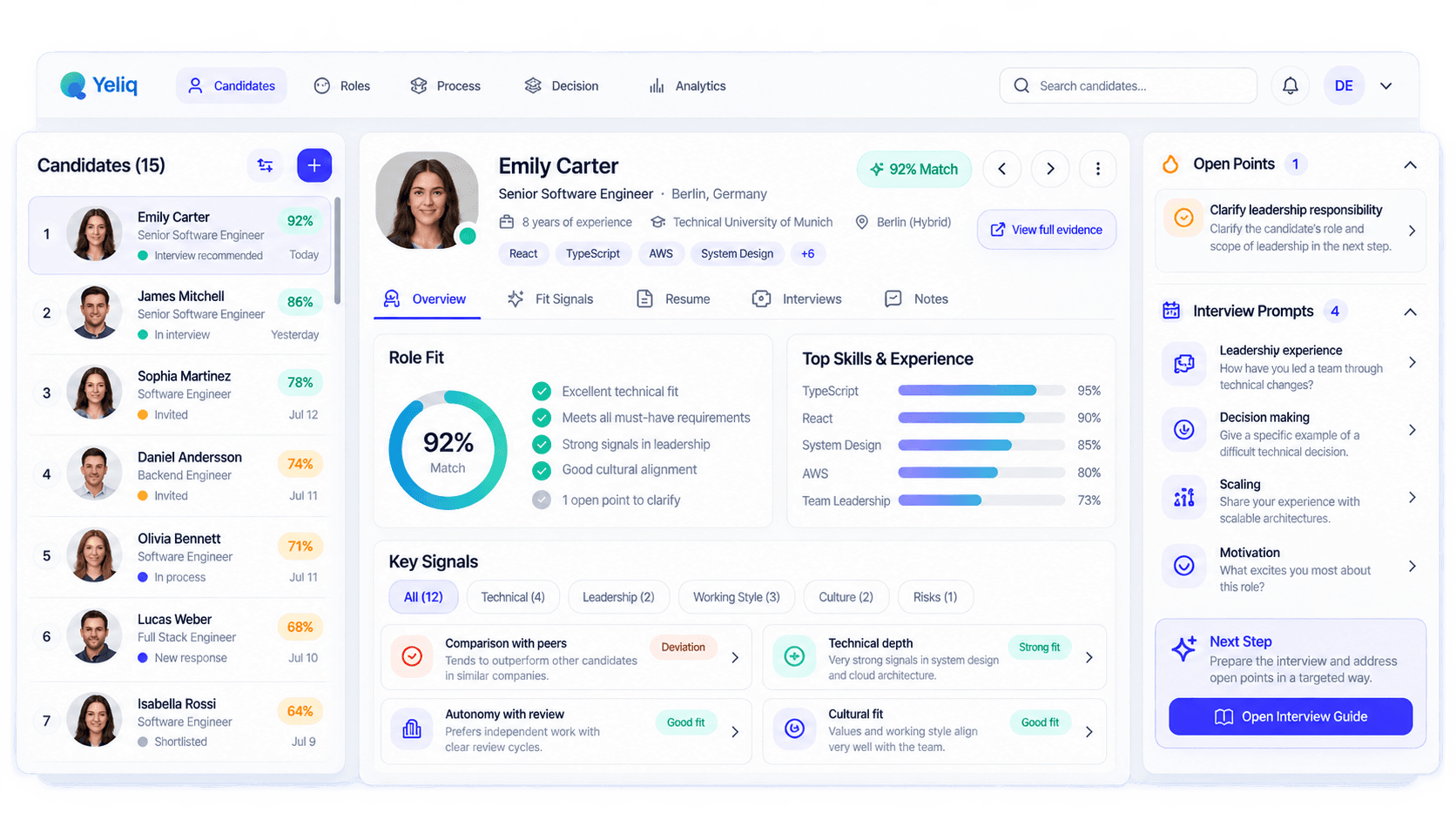
Recruiting and hiring managers see earlier which candidates are especially relevant for the concrete role.
Additional insight beyond the CV
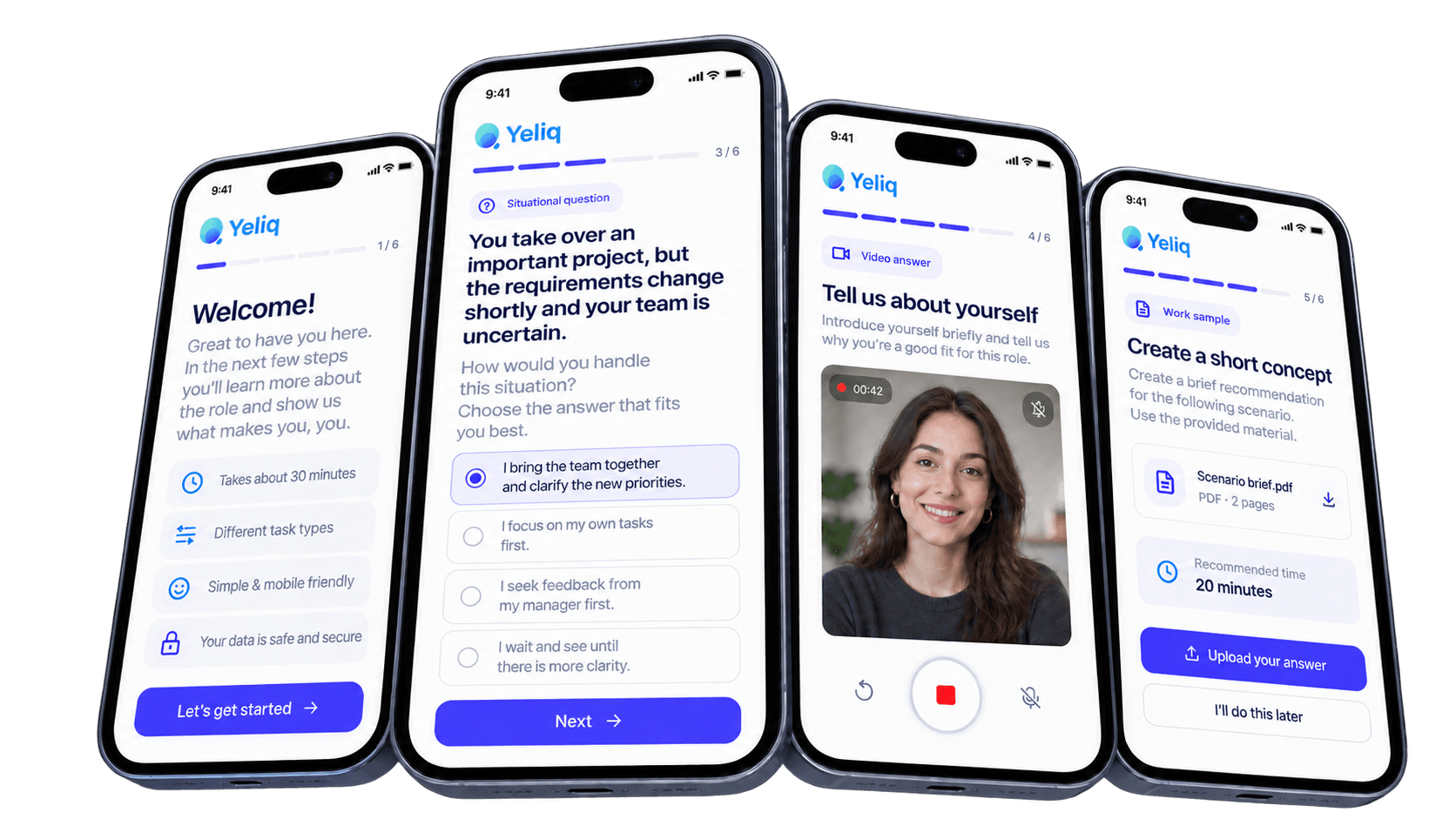
Situational answers make visible how candidates handle realistic requirements and tension areas in the role.
Prepare interviews with more precision
Every conversation comes with concrete pointers on strengths, tension areas and open questions to validate.
Role-specific modules
Yeliq uses the automated requirement analysis of the concrete role. Only the modules that provide relevant additional information before the first interview are combined from it.
Communication, presence and spontaneous response.
Video answer especially relevant
Communication, prioritization, customer situations and closing orientation.
Sales situations and communication especially relevant
Client work, structure, problem solving and project pressure.
Work sample and project logic especially relevant
Working style, decisions, ownership and team context.
Working style and leadership especially relevant
Case Study
The candidate prioritised first by ∘Yeliq made a strong impression in the first conversation and was later hired. This avoided not only additional first interviews, but also the related effort for scheduling, preparation, feedback and internal alignment.
“∘Yeliq mainly saved me time. I first looked at the top 5 by ∘Yeliq fit. The first conversation immediately showed that both the technical fit and the overall fit were there. I hired this candidate directly.”

Alex Marotz
Vice President Business Development, Motive Power at SOLV4EX Group
< 60 min.
setup in under 60 minutes
1 of 3
first interviews
66% fewer first interviews to reach the right candidate
30 min.
less preparation per candidate
1 round
saved in the later selection process
85 %
completion rate
Fewer first interviews mean more than less conversation time. Preparation, scheduling, feedback, alignment and possible follow-up effort are reduced as well.
Move faster to fitting candidates in growing teams.
More comparability in high volume hiring.
More signal for critical roles in complex operating environments.
Fit for teams across content, sales, product and speed.
Fit for client work, project pressure, ownership and manager fit.
Connect expertise earlier with client impact, standards and delivery.
Yeliq adds the information that is still missing for the concrete role before the first interview. Teams see earlier who deserves closer attention, which points remain open and where the interview should start.
Requirements, team context, leadership expectations and conditions are structured before screening.
Yeliq determines what the application and CV do not yet answer well enough for the first decision.
Candidates only answer the elements that create additional clarity for the concrete role.
The collected information shows earlier where strengths, open points and follow-up needs are.
Teams prioritize with more focus and enter the first conversation with concrete interview prompts.
Relevant signals
Depending on the role, Yeliq can combine situational questions, video answers, filter questions, work samples and existing application information. What matters is what creates a clearer basis for prioritization and interview preparation.
Realistic leadership situations show what kind of guidance, involvement and collaboration candidates prefer.
Realistic work situations show how candidates prefer to work around structure, autonomy, collaboration, decisions and pace.
Video answers add information when communication, expression, presence or spontaneous response are relevant for the role.
Filter questions check concrete requirements and conditions early in the selection process.
Digital work samples show how candidates actually approach a concrete, role-related task.
Automated CV analysis, qualifications, certificates or documents can also be included when they add further clarity for the role.
Before
How much effort does each role require today for review, preparation, interviews, feedback and internal alignment?
With ∘Yeliq
Which candidates are prioritised earlier, which interviews are prepared with more focus and where can unnecessary loops be avoided?
After
How do interview effort, number of conversations, preparation time and hiring manager feedback change?
The interview order is guided not only by the CV, but also by situational signals from the role.
Fewer conversations without outcome and less follow-up effort in the later selection process.
Recruiting and hiring managers receive additional insight and concrete conversation prompts for each person.
No black box decision
∘Yeliq does not make the hiring decision. It makes visible what teams often only discover in conversation today. The decision stays with recruiting, the hiring manager and the team.
Together, we look at one concrete role, your current selection process and the points where too much time is tied up today.


