
Pace does not fit the stage
Start-up, scale-up and enterprise SaaS require different ways of working.
SaaS
∘Yeliq helps SaaS teams see earlier who fits the pace, leadership, company stage and team and who really takes ownership.
Sales, Customer Success, Product, Engineering and Growth need more than matching skills. They need people who do well in the company's current growth stage.
Core thesis
Many profiles share similar logos, tools and playbooks. The difference lies in working style, self-direction and fit with the company stage.
Start-up, scale-up and enterprise SaaS require different ways of working.
A CV rarely shows whether someone really drives topics or needs strong structure.
Sales, CS, Product and Engineering often don't speak the same language.
The same role can call for very different strengths in a founder-led team, a scale-up or an enterprise company.
How much structure exists? How much must the person build?
Pipeline, conversion, customer success, expansion and prioritization.
Roadmap, discovery, tech debt, delivery and cross-functional decisions.
Leadership style, remote/hybrid, feedback and expectations for autonomy.
Pipeline, customer pressure, prioritization, resilience and clean handovers.
Customer impact, adoption, expansion, escalation and service mindset.
Discovery, delivery, communication and handling ambiguity.
Experiments, processes, data, enablement and scaling.
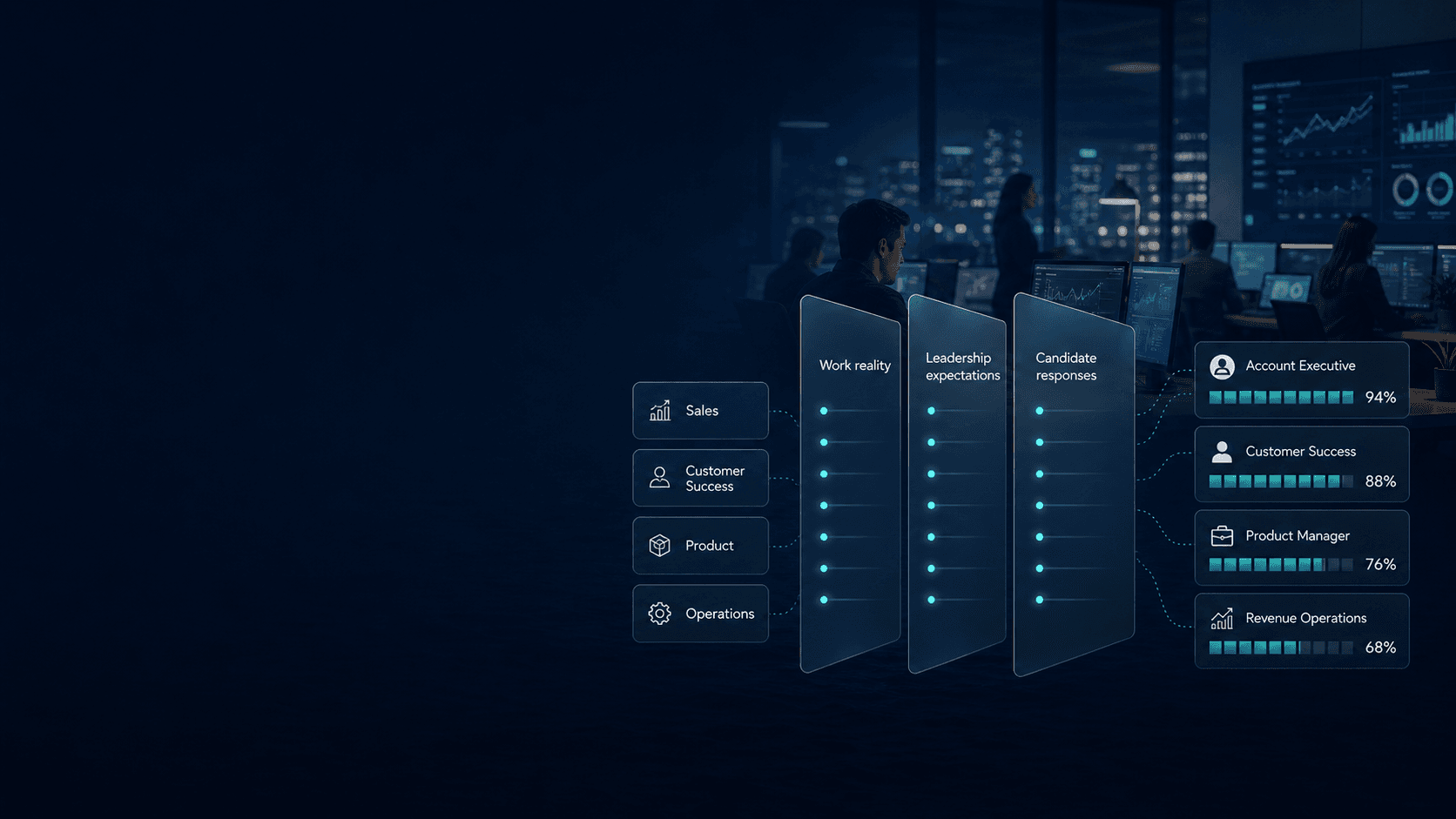
Hiring managers describe the stage, the team and what they expect in terms of ownership. Candidates respond to concrete SaaS situations instead of generic personality questions.
Teams see earlier who really fits the work reality.
Interviews go straight to ownership, pace and collaboration.
Recruiting delivers reasons, not just CVs and LinkedIn profiles.
Start-up, scale-up or enterprise: what is really required?
How much structure, feedback and autonomy does the team need?
You see how someone handles ownership, ambiguity, customers and other teams.
Teams see fit signals, tensions and interview focus.
Profiles become comparable earlier.
Conversations clarify what is actually still open.
Leadership expectations become part of early prioritization.
Pace, ownership and communication become visible earlier.
SaaS
These examples show typical configurations. The actual selection process is put together individually for each role based on its specific requirements.
| Yeliq module | Account ExecutivePipeline, pitch, objections and closing. | Customer Success ManagerOnboarding, adoption, escalation and expansion. | Software EngineerTechnical skill, approach and teamwork. | Implementation ConsultantCustomer projects, structure and expectation management. |
|---|---|---|---|---|
| CV analysis | ✓Recommended | ✓Recommended | ✓✓Highly relevant | ✓Recommended |
| Filter questions | ✓Recommended | ○Can be useful | ✓Recommended | ✓Recommended |
| Situational questions on working style | ✓✓Highly relevant | ✓✓Highly relevant | ✓Recommended | ✓✓Highly relevant |
| Situational questions on leadership | ✓Recommended | ✓Recommended | ○Can be useful | ○Can be useful |
| Video answer | ✓✓Highly relevant | ○Can be useful | ○Can be useful | ○Can be useful |
| Digital work sample | ○Can be useful | ✓Recommended | ✓✓Highly relevant | ✓✓Highly relevant |
Example in detail: Account Executive
Yeliq helps teams prioritize candidates earlier based on concrete work reality, leadership expectations and collaboration. This makes candidate overviews clearer and interviews more focused.
No. The CV remains relevant. Yeliq adds signals that are usually not visible in it: context, working style, leadership fit and possible tension areas.
A pilot usually starts with one role or role cluster. Role context, leadership expectations and candidate responses are then brought together in a structured way.
No. Yeliq provides signals, prioritization and interview focus. The final evaluation and decision stay with recruiting, the hiring manager and the team.
We start with one role or team and make ownership, pace and team fit visible before the interview.