
Newsroom pace meets product development
Deadlines, quality standards and digital development create friction between teams.
Media & Publishing
With ∘Yeliq, media companies, publishers and sales teams see earlier who will thrive in editorial, commercial and digital day-to-day work.
A portfolio shows expertise. It rarely shows how someone works with editorial, product, tech, sales and audience teams.
Core thesis
There are plenty of good profiles. What matters is who can handle pace, quality standards, reach targets and digital products.
Deadlines, quality standards and digital development create friction between teams.
Not everyone who creates strong content works well with commercial goals and audience data.
Editorial, product, tech and sales lose time when ownership stays unclear.
It's not just about whether someone can write, sell, produce or build. It's about how they work with other teams under deadlines and high quality standards.
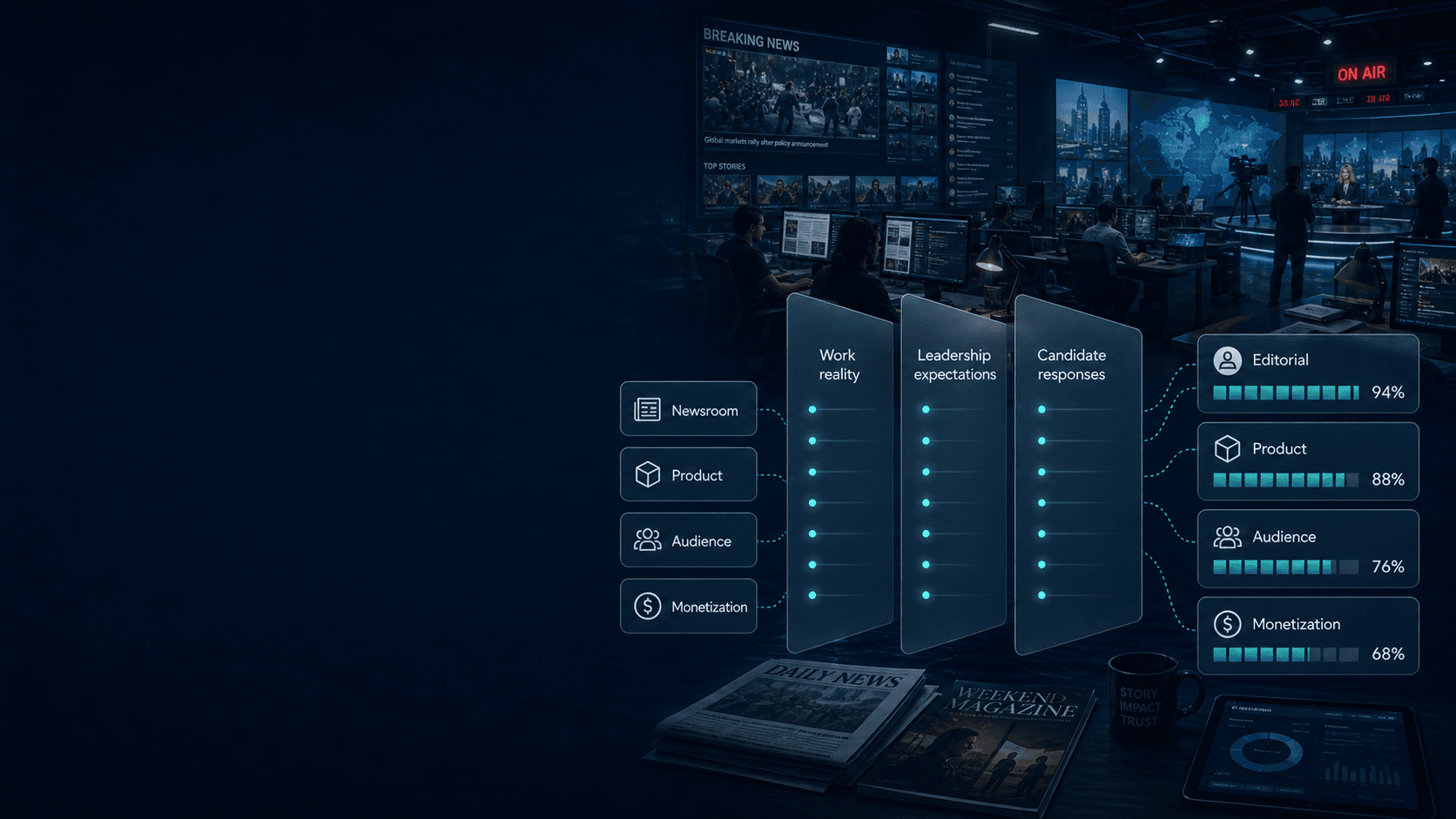
Newsroom, campaigns, releases and daily prioritization.
Editorial responsibility, brand, tone and decision confidence.
Users, subscription, data, reach and product impact.
Interfaces between content, platform, tech and monetization.
Judgment, pace, prioritization, research and responsibility.
Growth, data, subscription logic and product-adjacent decisions.
Roadmaps, platforms, user needs and editorial requirements.
Clients, campaigns, revenue pressure and alignment with content.
Hiring managers define what kind of collaboration the role really needs. Candidates respond to situations from editorial, product, sales or audience work.
Interviews start where collaboration often breaks down later.
Beyond the portfolio, you see how someone handles pace, quality and ownership.
Editorial, product or sales teams go into interviews with concrete questions.
Which pace, quality standards and interfaces shape the role?
What do editorial, product, sales or audience teams expect?
Candidates respond to typical points of tension from daily work.
Teams see where portfolio and working style align.
Portfolios are checked against real day-to-day work earlier.
Fit across editorial, product and monetization becomes clearer.
Teams check concrete questions instead of relying on gut feeling.
Profiles are judged by how someone works, not only by output.
Media & Publishing
These examples show typical configurations. The actual selection process is put together individually for each role based on its specific requirements.
| Yeliq module | EditorResearch, writing, pace and editorial judgment. | Audience managerData, reach and subscription growth. | Digital product ownerBringing roadmap, editorial and tech together. | Media salesClients, campaigns and revenue targets. |
|---|---|---|---|---|
| CV analysis | ✓Recommended | ✓Recommended | ✓Recommended | ✓Recommended |
| Filter questions | ○Can be useful | ○Can be useful | ○Can be useful | ✓Recommended |
| Situational questions on working style | ✓✓Highly relevant | ✓Recommended | ✓✓Highly relevant | ✓✓Highly relevant |
| Situational questions on leadership | ○Can be useful | ○Can be useful | ✓Recommended | ○Can be useful |
| Video answer | ○Can be useful | ○Can be useful | ○Can be useful | ✓Recommended |
| Digital work sample | ✓✓Highly relevant | ✓✓Highly relevant | ✓Recommended | ○Can be useful |
Example in detail: Editor
Yeliq helps teams prioritize candidates earlier based on concrete work reality, leadership expectations and collaboration. This makes candidate overviews clearer and interviews more focused.
No. The CV remains relevant. Yeliq adds signals that are usually not visible in it: context, working style, leadership fit and possible tension areas.
A pilot usually starts with one role or role cluster. Role context, leadership expectations and candidate responses are then brought together in a structured way.
No. Yeliq provides signals, prioritization and interview focus. The final evaluation and decision stay with recruiting, the hiring manager and the team.
We look at one concrete role and develop situations that fit your day-to-day work.