
Work realities differ
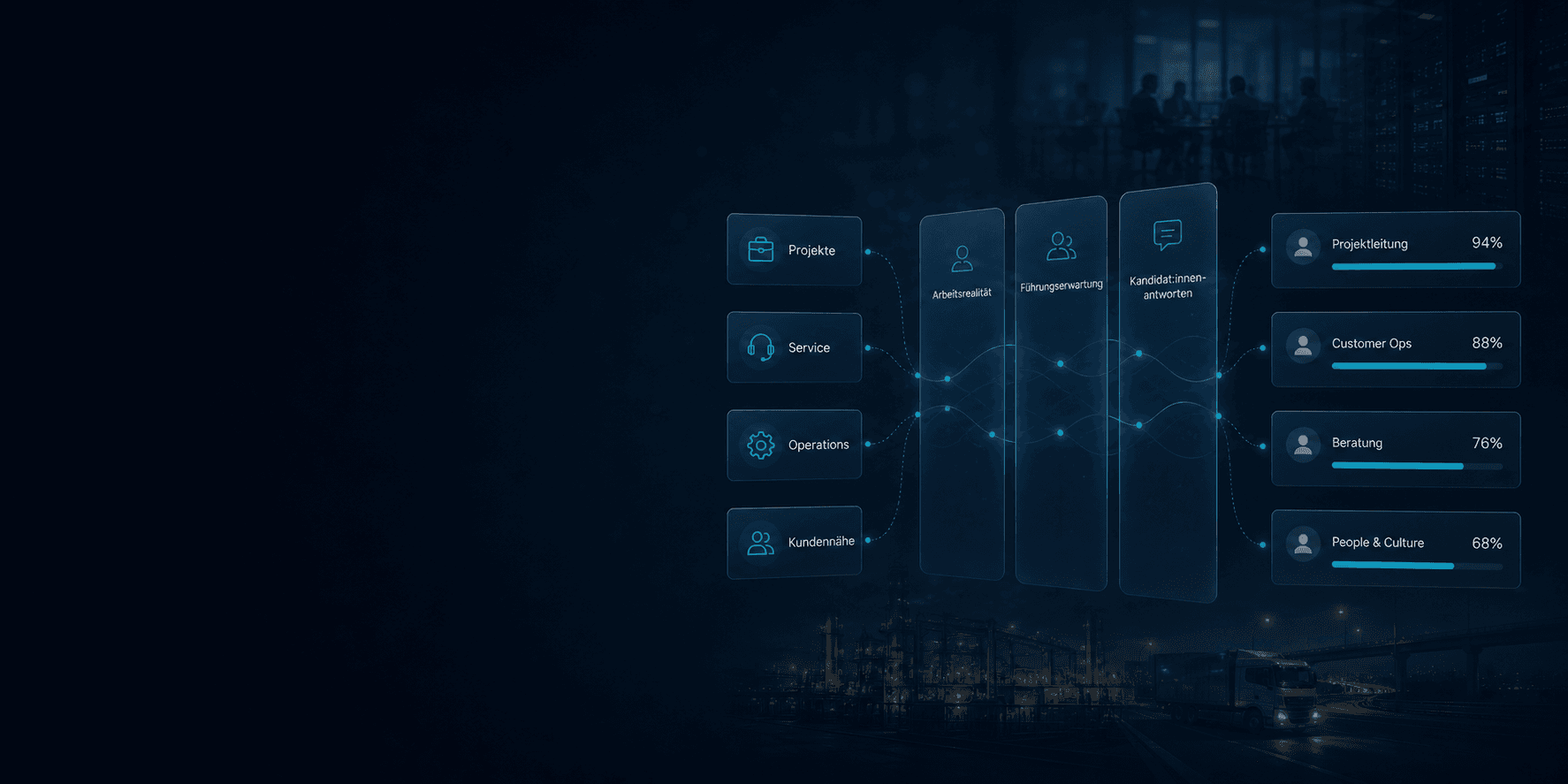
Pace, responsibility, risk, customer contact and teamwork look different everywhere.
Other industries
Whether someone fits depends less on the industry than on the actual day-to-day work. And that looks different everywhere, with its own situations, leadership expectations and success factors.
Together with you, ∘Yeliq develops questions and evaluation logic that fit your industry and your company.
Core thesis
Healthcare, pharma, logistics, manufacturing, public sector, education or finance have very different realities. One generic questionnaire cannot do that justice.
Pace, responsibility, risk, customer contact and teamwork look different everywhere.
The same role often needs very different strengths under a different manager.
Better prioritization comes from explicit criteria, not gut feeling.
Together we clarify which situations really matter in your industry, where people often fail and which signals would help before the interview.
Which realities shape work, responsibility and customers?
Which culture, leadership and processes make the difference?
Which situations separate strong from weak conversations?
Which signals should become fair, structured and comparable?
Diligence, responsibility, patient/customer proximity and regulation.
Pace, reliability, interfaces and operational responsibility.
Stakeholders, impact, processes, responsibility and communication.
Risk, accuracy, standards, customers and decision confidence.
We combine psychological foundations with the reality of your industry and company. The result is questions, signals and interview focus that don't feel generic.
No testing for its own sake, just the work and collaboration patterns that matter.
Situations that truly fit industry, role and leadership.
More structure before the first interview, without automating the decision.
Which situations, tensions and success factors shape the industry?
What makes your company different from generic role profiles?
We turn the day-to-day work into questions candidates answer in a structured way.
Together we refine fit signals, interview focus and fairness.
Prioritization reflects your work, not a generic HR standard.
Candidates are compared using explicit role-related signals.
Teams talk earlier about the points that are truly open.
People more often end up in roles that truly suit them.
Other industries
These examples show typical configurations. The actual selection process is put together individually for each role based on its specific requirements.
| Yeliq module | Registered nurseResponsibility, shift work and empathy. | Logistics dispatcherPlanning, pace and problem solving. | Production shift leadTeam leadership, safety and pace. | Bank client advisorAdvice, trust and regulatory requirements. |
|---|---|---|---|---|
| CV analysis | ✓Recommended | ✓Recommended | ✓Recommended | ✓Recommended |
| Filter questions | ✓✓Highly relevant | ✓Recommended | ✓✓Highly relevant | ✓✓Highly relevant |
| Situational questions on working style | ✓✓Highly relevant | ✓✓Highly relevant | ✓✓Highly relevant | ✓Recommended |
| Situational questions on leadership | ○Can be useful | ○Can be useful | ✓✓Highly relevant | ○Can be useful |
| Video answer | ○Can be useful | ○Can be useful | ○Can be useful | ✓Recommended |
| Digital work sample | ○Can be useful | ✓✓Highly relevant | ○Can be useful | ✓Recommended |
Example in detail: Registered nurse
Yeliq helps teams prioritize candidates earlier based on concrete work reality, leadership expectations and collaboration. This makes candidate overviews clearer and interviews more focused.
No. The CV remains relevant. Yeliq adds signals that are usually not visible in it: context, working style, leadership fit and possible tension areas.
A pilot usually starts with one role or role cluster. Role context, leadership expectations and candidate responses are then brought together in a structured way.
No. Yeliq provides signals, prioritization and interview focus. The final evaluation and decision stay with recruiting, the hiring manager and the team.
We check which work reality should become visible in your industry and whether a pilot makes sense.